aileenann
Thanks Received: 227
Atticus Finch
Atticus Finch
 
Posts: 300
Joined: March 10th, 2009


PT 44 S3 G2 During a certain week an animal shelter

by aileenann Mon Apr 19, 2010 6:19 pm

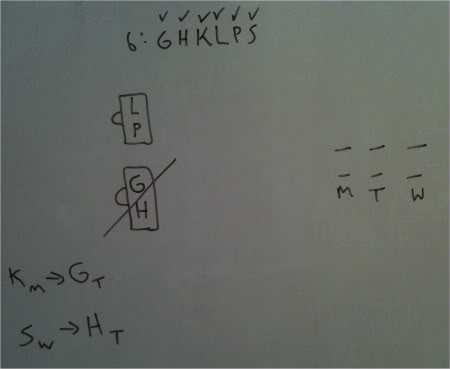
This is a closed assignment game. I've attached the diagram I used for this game, and I'd also like to discuss one of the questions below - question # 12. (Please let me know though if you'd like to see other questions for this game!) As is often the case with closed assignment games, it's difficult to make many or any inferences beyond the initial constraints - a lot seems up for grabs even after I've established my diagram.

For question # 12, they add an additional hypothetical - now they tell us that the greyhound is placed the day before the poodle. That effectively sets up a chunk that looks like this:

L
G P


Since there are only 3 slots, this chunk can either begin on Monday or Tuesday. Notice that in either case part of the chunk is on Tuesday. If G is on Tuesday, what we know is that H cannot be on Tuesday. If L and P are on Tuesday, nobody else can be on Tuesday. Therefore, the only element we can be sure can't be on Tuesday ever is H because it can't be on the same day as G. Thus our answer is (A).

Any questions :) ?
 
robowarren
Thanks Received: 0
Jackie Chiles
Jackie Chiles
 
Posts: 26
Joined: October 19th, 2011


Re: Diagram

by robowarren Sat Jan 21, 2012 4:36 pm

Hi,

It doesn't seem like you attached the diagram. Would you mind attaching?

robin
 
timmydoeslsat
Thanks Received: 887
Atticus Finch
Atticus Finch
 
Posts: 1136
Joined: June 20th, 2011
 
 
trophy
Most Thanked
trophy
First Responder
 

Re: Diagram

by timmydoeslsat Sat Jan 21, 2012 5:49 pm

I will post my diagram when I just did this game.

Image

We know that K and S could never go on the same day as each other because L and P are also together, which would force G and H together, which is not allowed.

We also know that L and P are interchangeable variables in this game, but since they go on the same day anyway, this doesn't have much power like in other games.
 
matthew.mainen
Thanks Received: 7
Jackie Chiles
Jackie Chiles
 
Posts: 45
Joined: March 25th, 2011


Re: Diagram

by matthew.mainen Thu Nov 07, 2013 11:37 am

 
steves
Thanks Received: 1
Elle Woods
Elle Woods
 
Posts: 53
Joined: January 13th, 2015


Re: Diagram

by steves Sat May 02, 2015 2:25 pm

This game seems important as it is covered in both the Interact lesson 8 and the LG study guide. My question is on the best solution strategy for timing. I've also done this game using frames, like those above. On my 3rd attempt at the game, the initial set-up took 1 minute, orientation question 1 minute, frames 4 minutes, questions 8-12 4-1/2 minutes using the frames--for a total of 10-1/2 minutes. The 2nd attempt took 18 minutes. I was completely lost when I tried to do questions 8-12 without using frames on my 1st attempt.

The only reason this went relatively fast on the 3rd attempt was being familiar with the problem. A similar but unfamiliar problem is still likely to take me much longer. My greatest time sink was in developing the frames, which took much longer during the 2nd attempt to get them correct with the conditional rules.

Is framing the most efficient way to solve a game like this--or is there another approach that makes it easier to keep the rules straight? If framing is the best way, is there a way to more efficiently and accurately put the frames together with the rules? I had already figured out that G&H and S&K had to be split to different days for the 2nd attempt.
User avatar
 
tommywallach
Thanks Received: 468
Atticus Finch
Atticus Finch
 
Posts: 1041
Joined: August 11th, 2009
 
This post thanked 1 time.


Re: Diagram

by tommywallach Thu May 07, 2015 10:16 pm

Hey Steves,

Unfortunately, I do believe these are your two options. You can frame out, which is a bigger investment up front, or you can go with the Timmy-style outline, but then you have more work on the back-end. A GENERAL rule of thumb often says that if you're going to have more than two frames, it might not be worth doing them (particularly as the three frames here still have a fair amount of uncertainty inherent to them); that's usually my deciding factor. That being said, there's no right or wrong answer here, merely a question of what works better/faster for you.

-t
Tommy Wallach
Manhattan LSAT Instructor
twallach@manhattanprep.com
Image