5th Edition Manhattan GMAT Strategy Guides Giveaways!
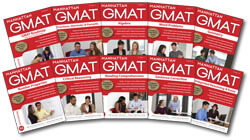
In celebration of the release of our 5th Edition Strategy Guides, we’re giving away a complete set (10 books!) to one lucky person. For a chance to win the beautiful books you see to your left, head over to our Facebook page and “like” our post announcing the giveaway. We’ll pick one person at random Friday afternoon. If we get over 100 “likes”, we’ll give away a second set of books, so get as many people to “like” it as you can!
We’ll also be giving away a complete set of 5th Edition Strategy Guides on Twitter at some point this week, and in the next issue of our newsletter, GMATTERS, as well as a few other places online. Keep your eyes peeled for a chance to win! Or, if you can’t wait, head over to our store and pick up the books now and see how great they really are.
Update, 4/26/12: We’re giving away a set of 5th edition books on GMAT Club and Beat the GMAT. Post on the linked threads for a chance to win!
The 5th Edition Manhattan GMAT Strategy Guides Have Arrived!
We are excited to announce the release of our new 5th Edition GMAT Strategy Guides! Months of intensive work by our 99th percentile instructors has resulted in what we believe are the finest GMAT prep books money can buy. The 10 5th Edition books (which amount to nearly 1,900 pages!) were designed with our content-based approach to prepare students for the most recent changes to the GMAT, including Integrated Reasoning. The 5th Edition Strategy Guides come with access to 6 free online practice exams as well as access to over 200 additional free practice questions in 9 subject-specific question banks.
Interested in learning more? Check out the individual book pages in our MGMAT Store. We’re also going to have a lot of great content and giveaways relating to the new 5th Edition guides on the blog this week so make sure you check back every day!
Chasing Superman: Change In Distance As Work On The GMAT
Editor’s Note: This is the first post by Manhattan GMAT instructor Avi Gutman. Toronto-based, England-born (to Scottish and Moldovan parents), and Israel-raised, Avi likes to consider himself an international man of mystery. The publication of this post was delayed a week due to Avi’s wedding! Welcome him to our blog and send him your congratulation in the comment section below!

Raise your hand if you cringe whenever you think of word problems from 8th grade. Raise your hand again if you feel queasy when you see a question involving Train A and Train B.
If your hand is getting tired this blog post is for you. Most of us already know that GMAT problems involving moving objects (people, cars, trains, etc.) are just one particular form of a WRT (Work Rate Time) problem, where the work is simply the distance traveled. When dealing with just one moving object we can apply the DRT formula as usual (Distance=Rate*Time), but the test writers know that by throwing two moving objects at us (figuratively!) they raise the level of the problem by some 200 points.
You Play Like You Practice
 Editor’s Note: This is the first post by Manhattan GMAT instructor Joe Lucero. Give Joe a warm welcome in the comments section!
Talking to students and instructors over the years, I’ve heard my fair share of horror stories about the GMAT. The I ran out of time students are a dime a dozen, but there are several I was exhausted and couldn’t concentrate at the end of the test and even a few I didn’t realize how short the bathroom breaks are and had to run back to my computer which had already started the next section tales. But my favorites come from students who decided to drastically alter their routines the day of the test, from the student who decided a 5 mile run was going to be good for his nerves (but not for his tired legs, lungs, and brain) to the decaf drinker who decided a few five hour energies would help him stay focused (it didn’t).
Back when I used to coach middle school basketball, our team had a slogan- you play like you practice. When our kids would be goofing around, not paying attention, or being sluggish, they’d hear those words over and over again. And while it’s cliché in the gym, working with students who aren’t performing as high as they would like on the GMAT, I find myself repeating the same pieces of advice.
Read more
The Next-Gen GMAT: Two-Part Analysis

You may have already heard that GMATPrep 2.0 has been released. I’m pretty excited that we finally have a mac-compatible program “ after all, what better way to spend a random Friday night when I’m bored? : ) Seriously, though, I just tried my first CAT yesterday and I’ve got an IR question that I want to share with you.
Note: IR is not adaptive; in other words, we’re all going to see the same questions when we take the two practice CATs. So, if you haven’t taken your first GMATPrep 2.0 CAT yet, you might just want to bookmark this article right now and wait. Once you’ve taken the test, you can come back and read the rest of the article. Read more
Free Integrated Reasoning Workshops!
Update, 5/7/12: We’ve added four more workshops! See the dates and register here. Hurry, before these sell out too!
Manhattan GMAT is offering a series of free online Integrated Reasoning workshops hosted by our Vice President of Academics Chris Ryan. Chris will dive deeply and provide hands-on techniques for tackling the new IR section. You do NOT want to miss this!
Below are the dates and links to where you can sign up for a workshop. Hope to see you (virtually) there!
April 14th (12-2 pm EST) — SOLD OUT
April 16th (7-9 pm EST) — SOLD OUT
April 19th (9:30-11:30 pm EST) — SOLD OUT
April 21th (12-2 pm EST) — SOLD OUT
April 23rd (7-9 pm EST)
April 26th (9:30-11:30 pm EST)
April 28th (12-2 pm EST)
Critical Thinking Does Not Equal GMAT Critical Reasoning, Part 2
Editor’s Note: This is Part 2 of our new blogger Andrea Pawliczek‘s first post. You can read Part 1 here.
Let’s take an example of a critical reasoning argument that might appear on the GMAT.

Plainsboro Hospital completed a study that revealed that the majority of post-operative bacterial infections are caused by catheters. In order to reduce post-operative infections, Plainsboro Hospital decided to implement new sterilization procedures to kill bacterial on catheters before they are inserted into post-operative patients.
Real World Analysis
Take a minute to brainstorm some of the questions you might ask if you were a manager at Plainsboro hospital evaluating the proposal to implement this plan.
Read more
The Next-Gen GMAT: Graphics Interpretation

The launch of the Integrated Reasoning (IR) section is getting close! The last administration of the old version of the GMAT will be on 2 June; the next-generation GMAT will launch on 5 June. It’s not too late to study for the old version, but it’s also not too early to start thinking about studying for the next-gen test, including IR.
So let’s talk about one of the four IR question categories: Graphics Interpretation. IR in general is a mix of quant and logical reasoning, so expect to bring your critical reasoning and reading comp skills into play on this section.
Before we dive in, just a note: a new Official Guide (13th edition!) was just published; it has an IR section along with an additional IR resource online (to which you get access if you buy the book). I would guess that most test prep companies will also be releasing their IR study materials next month (we certainly are!).
The Next Generation GMAT: Two-Part Analysis

The launch of the Integrated Reasoning (IR) section is getting close! The last administration of the old version of the GMAT will be on 2 June; the next-generation GMAT will launch on 5 June. It’s not too late to study for the old version, but it’s also not too early to start thinking about studying for the next-gen test, including IR.
So let’s talk about one of the four IR question categories: the Two-Part Analysis. IR in general is a mix of quant and logical reasoning, so expect to bring your critical reasoning and reading comp skills into play on this section.
Read more
Debunking the “First 7 Questions” Myth
I don’t even need to say what the myth is! Everyone already knows—that’s how pervasive it is. Ever since the GMAT and GRE CATs launched in the 1990s people have believed that the earlier questions are worth more, that if we could get the first 7 (or 5, or 10) questions in a row right, we’d be guaranteed a really high score.
And you’ve likely also heard that this is a myth: from me, from other teachers, from Dr. Lawrence (Larry) Rudner, Chief Psychometrician of GMAC (the organization that makes the GMAT). And yet so many people still talk about it and believe it—so who should we believe?
Let’s talk about this and, hopefully, lay the myth to rest once and for all.
